
Introduction
In the fast‑paced world of quick‑service restaurants, few brands manage to balance growth with authenticity. Freddy’s Frozen Custard & Steakburgers has done just that — earning the title of Quick Flip: Top QSR Burger Franchise for its remarkable expansion, franchise relationships, and consistent return‑on‑investment performance.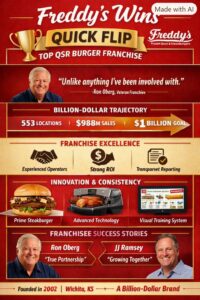
A Legacy of Partnership
Freddy’s success story is built on relationships. Veteran franchisee Ron Oberg, who operates 21 units across six states, describes the connection between franchisees and corporate leadership as “unlike anything I’ve been involved with.”
Oberg, the brand’s first franchisee nearly two decades ago, has seen Freddy’s evolve through leadership changes and a private‑equity acquisition — yet accessibility and collaboration remain constant.
Founded in Wichita, Kansas, in 2002 by Scott Redler and brothers Bill and Randy Simon, Freddy’s was acquired by Thompson Street Capital Partners in 2021. The company has since opened a training and innovation center in Wichita, reinforcing its commitment to franchise development and operational excellence.
The Billion‑Dollar Trajectory
Freddy’s closed 2024 with 553 restaurants and approximately $988 million in systemwide sales, putting it on track to surpass the $1 billion milestone.
Its recognition in the Quick Flip category highlights:
- Strong ROI potential for franchisees.
- Rapid yet strategic expansion across U.S. markets.
- Transparent financial reporting in its franchise disclosure document.
This disciplined growth model ensures that Freddy’s remains both profitable and sustainable — a rare balance in the QSR sector.
Strategic Franchise Growth
Freddy’s approach to new operators is deliberate. “They’re bringing in franchisees that have multiple concepts,” Oberg explained, citing partners from brands like Zaxby’s and Burger King.
The brand prioritizes experienced operators who understand the nuances of restaurant management — ensuring that every new location upholds Freddy’s standards of quality and hospitality.
Innovation That Serves Consistency
Freddy’s innovation extends beyond menu development. The introduction of the Prime Steakburger and back‑of‑house technology has streamlined operations.
Oberg’s stores now use a burger‑smashing machine that guarantees perfect consistency — “whether it’s the first burger of the day or the last.”
Freddy’s is also rolling out a visual kitchen display system, enabling cooks — including those who speak English as a second language — to follow step‑by‑step visual guides. This reduces errors, speeds up service, and enhances training efficiency.
Franchisee Success Stories
Oberg’s journey from a four‑unit deal in 2004 to a multi‑state operation exemplifies Freddy’s franchise potential. His team includes managers celebrating 10 to 15 years with the company — proof of Freddy’s culture of growth and loyalty.
Further south, JJ Ramsey of Ram‑Z Restaurant Group operates 33 Freddy’s units across Oklahoma, Texas, and Ohio. Ramsey praises the brand’s support system: “Everything they said they would do, they have done — from phone calls to visits to the CEO being at your restaurant on opening day.”
Ramsey’s group often acquires underperforming locations and revitalizes them through Freddy’s operational model, achieving steady sales growth toward the brand’s average unit volume of $1.8 million.
Conclusion
Freddy’s Frozen Custard & Steakburgers stands as a model of franchise excellence — blending innovation, partnership, and consistency to create lasting success.
From its humble beginnings in Wichita to its billion‑dollar trajectory, Freddy’s proves that the secret to quick‑service growth isn’t speed alone — it’s trust, teamwork, and timeless flavor.
See More: Freddy’s Jalapeño Pepper Jack Double Combo