
Introduction
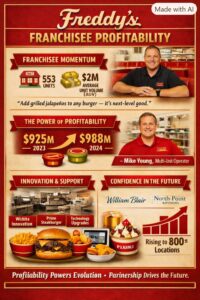
Inside the scarlet‑red booths of Freddy’s new training and innovation center in Wichita, Kansas, CEO Chris Dull leans back with a grin and offers a simple menu hack: “Add grilled jalapeños to any burger — it’s next‑level good.”
That casual confidence reflects the spirit of Freddy’s today — a brand balancing nostalgia with innovation, and growth with grounded leadership. As Freddy’s approaches $1 billion in systemwide sales, its evolution is being powered not just by corporate strategy, but by the profitability and passion of its franchisees.
A Brand Built on Partnership
Dull, a former Baylor University linebacker now in his fourth year as CEO, has overseen Freddy’s expansion to 553 units and an average unit volume approaching $2 million.
Franchisees are the driving force behind that growth. Operators like Mike Young, who opened his first Freddy’s in Iowa in 2015 and is preparing to unveil his 12th location, embody the brand’s momentum. Despite rising construction and operating costs, Young continues to invest — recently acquiring development rights for Rochester, Minnesota, and La Crosse, Wisconsin.
“I have a lot of confidence,” Young says. “Or I wouldn’t be signing up for more territories.”
That confidence stems from Freddy’s consistent support system, transparent financials, and a franchise model that prioritizes long‑term profitability over short‑term expansion.
The Power of Profitability
Freddy’s finished 2023 with $925 million in total sales, projecting $988 million for 2024 — a 45 percent unit growth since 2019.
Private‑equity owner Thompson Street Capital Partners, which acquired Freddy’s in 2021, attributes much of that success to franchisee satisfaction. Managing Director Joe St. Geme explains:
“The most important thing is making sure your franchisees are happy, they feel supported, they have the resources they need. As long as we’re doing that, the rest mostly takes care of itself.”
That philosophy translates into tangible investment — from multimillion‑dollar facilities and supply‑chain improvements to pricing studies designed to boost average unit volumes (AUVs).
Innovation Rooted in Franchise Feedback
Freddy’s new training and innovation center in Wichita is more than a corporate hub — it’s a collaborative space where franchisees, operators, and culinary teams test ideas together.
Menu innovation, like the Prime Steakburger and Dull’s beloved jalapeño hack, reflects Freddy’s commitment to keeping flavor fresh while maintaining operational simplicity.
Technology upgrades, including visual kitchen display systems and automated burger‑smashing machines, ensure consistency and efficiency across all units — innovations that directly improve franchisee margins.
Confidence in the Future
Thompson Street Capital Partners is now exploring a potential sale of Freddy’s, working with investment banks William Blair and North Point Advisors. While details remain undisclosed, Dull views the possibility as a positive step.
“We’ve done well, and I think the groups that will be interested in acquiring a business like this are groups that probably have tremendous experience in this space and can really help bring that next level of value add,” he says.
That optimism underscores Freddy’s evolution — a brand confident in its foundation, propelled by franchisee success, and ready for its next chapter.
Conclusion
Freddy’s Frozen Custard & Steakburgers isn’t just expanding; it’s evolving through partnership. Franchisee profitability has become the compass guiding every decision — from menu innovation to technology investment.
As Chris Dull jokes about jalapeños and future growth, one thing is clear: Freddy’s flavor may be timeless, but its business model is built for the future — a future where franchisees thrive, and the brand’s billion‑dollar dream becomes reality.