
A Deep Dive into Ingredients, Nutrition, and Ethical Dining
🏁 Introduction
Freddy’s Frozen Custard & Steakburgers® has built its reputation on classic American comfort food — juicy steakburgers, crispy shoestring fries, and creamy frozen custard. Yet, tucked between those layers of indulgence lies a surprisingly simple ingredient that sparks curiosity among health‑conscious diners: Freddy’s pickles.
These tangy slices add crunch and brightness to every burger, but for those following vegan or gluten‑free diets, one question often arises: Are Freddy’s pickles safe and suitable for everyone?
The answer is yes — Freddy’s pickles are both vegan and gluten‑free. But understanding why requires a closer look at their ingredients, sourcing, preparation, and the broader context of dietary inclusivity in fast‑casual dining.
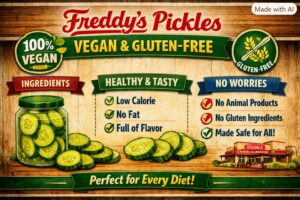
🧩 Understanding Freddy’s Pickles
Freddy’s pickles are classic dill slices, typically served on steakburgers, sandwiches, and chicken options. They’re thin, crisp, and tangy — the kind that balances the richness of beef and cheese with a refreshing bite.
Composition
- Base: Fresh cucumbers.
- Brine: Vinegar, water, salt, and dill.
- Seasoning: Garlic, mustard seed, and natural spices.
- Preservatives: Minimal, often citric acid or calcium chloride for crunch retention.
No animal‑derived ingredients are used, and no gluten‑containing additives appear in the brine or seasoning mix.
🌱 Vegan Certification Explained
To qualify as vegan, a food must contain no animal products or by‑products — including dairy, eggs, honey, gelatin, or animal‑based enzymes.
Freddy’s pickles meet this standard because:
- The cucumbers are plant‑based.
- The brine uses vinegar derived from plant fermentation, not animal sources.
- No gelatin or whey is used for texture or preservation.
- The spices and flavorings are botanical.
While Freddy’s doesn’t carry an official “Vegan Certified” label for its pickles, ingredient transparency confirms they align with vegan principles.
🌾 Gluten‑Free Assurance
Gluten is a protein found in wheat, barley, and rye. It can appear in sauces or seasonings through malt vinegar or wheat‑based thickeners.
Freddy’s pickles avoid these entirely. The vinegar used is distilled white vinegar, which is gluten‑free because the distillation process removes gluten proteins.
Key Gluten‑Free Factors
- No malt vinegar.
- No wheat‑based stabilizers.
- No cross‑contamination during packaging.
However, cross‑contact may occur in restaurant kitchens where buns or breaded items are handled nearby.
⚠️ Cross‑Contact Considerations
Freddy’s kitchens are shared spaces. While the pickles themselves are gluten‑free and vegan, they may come into contact with surfaces used for non‑vegan or gluten‑containing foods.
Tips for Sensitive Diners
- Request fresh pickles added separately.
- Ask staff to use clean utensils.
- Avoid ordering items that include buns or breaded proteins if you have celiac disease.
Freddy’s staff are trained to accommodate dietary requests, but communication is key.
🧠 Nutritional Breakdown
| Nutrient | Per Serving (≈ 30 g) | Notes |
|---|---|---|
| Calories | 5–10 kcal | Very low‑calorie condiment. |
| Fat | 0 g | Naturally fat‑free. |
| Carbohydrates | 1–2 g | Minimal sugar from brine. |
| Sodium | 250–300 mg | Moderate; contributes to flavor. |
| Fiber | 0.5 g | From cucumber skin. |
| Protein | 0 g | Plant‑based, no animal protein. |
Freddy’s pickles are a low‑calorie, low‑fat, high‑flavor addition — ideal for those managing weight or sodium intake.
🍔 Role in Freddy’s Menu
Pickles appear in several Freddy’s menu items:
- Original Double Steakburger.
- California Style Burger.
- Grilled Chicken Sandwich.
- Veggie Burger (where available).
They serve as a flavor contrast — cutting through richness and adding crunch. For vegan diners, pickles are one of the few components that remain fully plant‑based even in meat‑centric dishes.
🧩 Supplier Standards
Freddy’s sources its pickles from reputable food manufacturers that follow FDA allergen labeling and Good Manufacturing Practices (GMP).
These suppliers ensure:
- No animal‑derived processing aids.
- No gluten‑containing ingredients.
- Consistent quality and safety across batches.
This commitment aligns with Freddy’s broader focus on transparency and customer trust.
🌍 Ethical and Environmental Impact
Choosing vegan ingredients like pickles contributes to sustainability. Cucumbers require less water and land than animal‑based foods, and vinegar production has a low carbon footprint.
Freddy’s inclusion of vegan condiments reflects a growing trend in ethical fast‑casual dining, where even small ingredients support plant‑forward values.
🧩 Culinary Versatility
Freddy’s pickles aren’t just burger toppings — they’re versatile flavor enhancers.
Creative Uses
- Salads: Add tang and crunch.
- Wraps: Replace sauces for a lighter bite.
- Vegan sandwiches: Pair with hummus or avocado.
- Side dishes: Chop into relish or coleslaw.
Their acidity balances rich foods and enhances plant‑based meals beautifully.
🧩 Consumer Perception
Freddy’s fans often praise the pickles for their crispness and flavor balance. Online reviews highlight how they “make the burger pop” and “taste homemade.”
For vegan and gluten‑free diners, these pickles symbolize inclusivity — proof that even traditional burger chains can cater to diverse dietary needs.
🧩 Hospitality Perspective
From a hospitality standpoint, Freddy’s approach to simple, transparent ingredients builds trust. Offering naturally vegan and gluten‑free condiments allows the brand to serve a wider audience without complex menu changes.
This strategy enhances customer satisfaction and positions Freddy’s as a modern, inclusive diner that respects dietary diversity.
🧩 Scientific Insight: Why Pickles Are Naturally Vegan
Pickling is a preservation method that relies on acidic brine or fermentation, not animal products.
Process Overview
- Cucumbers are washed and sliced.
- They’re submerged in vinegar, salt, and spices.
- The acidity prevents bacterial growth.
- Natural fermentation may occur, enhancing flavor.
This process is inherently plant‑based, making pickles one of the oldest vegan foods in history.
🧩 Gluten‑Free Science
Distilled vinegar is gluten‑free because distillation separates volatile compounds from solids. Gluten proteins are non‑volatile, meaning they don’t carry over into the final liquid.
Thus, even if vinegar originates from wheat, the finished product contains no gluten residue. Freddy’s uses distilled white vinegar, ensuring safety for gluten‑sensitive diners.
🧩 Comparative Analysis: Freddy’s vs. Competitors
| Brand | Vegan? | Gluten‑Free? | Notes |
|---|---|---|---|
| Freddy’s | ✅ Yes | ✅ Yes | Classic dill slices, clean ingredients. |
| Five Guys | ✅ Yes | ✅ Yes | Similar profile, slightly saltier. |
| Shake Shack | ✅ Yes | ✅ Yes | Uses house‑made pickles, more tangy. |
| Culver’s | ✅ Yes | ✅ Yes | Slightly sweeter brine. |
Freddy’s pickles stand out for their crisp texture and balanced acidity — ideal for both vegan and gluten‑free diners.
🧩 Cultural History of Pickles
Pickles are among the oldest preserved foods in human history. Archaeological evidence suggests cucumbers were pickled in Mesopotamia over 4,000 years ago. Across cultures, pickling became a way to extend shelf life, enhance flavor, and add variety to diets.
- Middle Eastern roots: Vinegar‑based pickling spread through trade routes.
- European tradition: Dill pickles became staples in German and Polish cuisine.
- American diners: Pickles gained popularity in the early 20th century as a cheap, flavorful burger topping.
Freddy’s adoption of dill pickles reflects this classic diner heritage, connecting modern fast‑casual dining to timeless culinary traditions.
🧩 Pickles in American Fast Food
Pickles are a defining element of American burgers. They provide acidity that cuts through fat, balancing flavors.
- McDonald’s: Thin dill slices, slightly sweet.
- Burger King: Larger, tangier slices.
- Freddy’s: Crisp, balanced dill pickles — closer to homemade style.
Freddy’s stands out by offering pickles that are vegan, gluten‑free, and flavor‑forward, appealing to both traditional diners and health‑conscious customers.
🧩 Psychological Role of Pickles
Pickles enhance the sensory experience of eating:
- Crunch: Adds texture contrast.
- Tang: Stimulates appetite.
- Color: Bright green slices add visual appeal.
For vegan and gluten‑free diners, pickles provide a sense of inclusion — a condiment that is universally safe and enjoyable.
🧩 Hospitality Strategy
Freddy’s decision to use vegan and gluten‑free pickles is not accidental. It reflects a broader hospitality strategy:
- Inclusivity: Ensures more customers can enjoy the menu.
- Simplicity: No need for separate vegan/gluten‑free versions.
- Brand trust: Transparency builds loyalty among health‑conscious diners.
This approach positions Freddy’s as a modern diner brand that respects diverse dietary needs without complicating its menu.
🧩 Health Benefits of Pickles
While pickles are often seen as indulgent condiments, they offer notable health benefits:
- Probiotics: Fermented pickles support gut health.
- Low calorie: Adds flavor without excess calories.
- Hydration: Cucumbers are water‑dense.
- Antioxidants: Dill and garlic provide micronutrients.
For vegan and gluten‑free diners, pickles are a guilt‑free way to enhance meals.
🧩 Challenges in Vegan/Gluten‑Free Dining
Fast‑food dining often poses challenges for restricted diets. Hidden ingredients, cross‑contact, and limited options can frustrate customers.
Freddy’s pickles stand out as a safe, transparent choice — proof that even small menu items can make a big difference in inclusivity.
🧩 Consumer Testimonials
Fans frequently highlight Freddy’s pickles in reviews:
- “The crunch makes the burger perfect.”
- “I’m vegan, and I love that the pickles are safe.”
- “Gluten‑free and delicious — I wish more chains were this clear.”
These voices reinforce the importance of ingredient transparency in building customer trust.
🧩 Comparative Hospitality Analysis
Compared to competitors, Freddy’s excels in clarity:
- McDonald’s: Pickles are vegan/gluten‑free but less emphasized.
- Five Guys: Similar profile, but higher sodium.
- Shake Shack: House‑made pickles, tangier but less consistent.
- Freddy’s: Crisp, balanced, clearly safe for restricted diets.
This positions Freddy’s as a leader in inclusive condiment strategy.
🏁 Conclusion
Freddy’s pickles are vegan and gluten‑free, making them a safe, flavorful, and inclusive choice for all diners. Their role extends beyond taste — they symbolize Freddy’s commitment to hospitality, transparency, and inclusivity in fast‑casual dining.
- Vegan assurance: No animal products or by‑products.
- Gluten‑free safety: Distilled vinegar, no wheat additives.
- Cultural heritage: Rooted in diner tradition.
- Hospitality strategy: Builds trust and inclusivity.
For health‑conscious, ethical, or restricted‑diet diners, Freddy’s pickles are more than a garnish — they’re a statement of modern dining values.