
A Freddy’s Concrete Mixer® is one of the chain’s most popular frozen custard treats, loved for its thick, creamy texture and nearly endless customization possibilities. Whether you order it loaded with candy pieces, cookies, fruit, or sauces, one question often comes up: How long can a Freddy’s Concrete Mixer sit out before it starts to melt?
The answer depends on several factors, including ambient temperature, serving size, ingredients, and how quickly it’s eaten. While there is no official Freddy’s published melting time, understanding how frozen custard behaves can help you estimate how long your Concrete Mixer will maintain its signature thickness.
What Makes a Concrete Mixer Different?
Unlike a traditional ice cream sundae or milkshake, a Freddy’s Concrete Mixer is made with frozen custard and mixed with toppings until thick enough to hold its shape.
Frozen custard differs from regular ice cream because it contains egg yolks in addition to cream and sugar. This composition creates a denser, smoother, and creamier product that tends to melt differently than standard soft-serve ice cream.
Because Concrete Mixers are intentionally blended to be thick, they generally hold their structure longer than a milkshake but not indefinitely.
How Quickly Does a Concrete Mixer Start Melting?
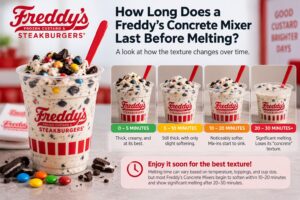
Under normal indoor conditions, a freshly served Freddy’s Concrete Mixer will usually begin to soften almost immediately once served.
Within the first:
5 to 10 Minutes
- The mixer typically remains very thick.
- Most toppings stay suspended throughout the custard.
- The texture closely resembles what it was when prepared.
This is generally considered the ideal window for enjoying the treat.
10 to 20 Minutes
- The outer edges begin softening noticeably.
- Mix-ins near the surface may start sinking.
- The custard becomes easier to scoop.
Many guests still find the texture enjoyable during this stage.
20 to 30 Minutes
- Melting becomes much more visible.
- The treat starts losing its dense “concrete” consistency.
- Liquid custard can begin collecting around the edges.
At this point, the dessert starts transitioning from a thick frozen treat into a softer custard experience.
Beyond 30 Minutes
- Significant melting is likely.
- The original texture is largely lost.
- Candy and cookie toppings may become soggy.
The exact timing varies substantially depending on environmental conditions.
Why Some Concrete Mixers Last Longer
Not all Freddy’s Concrete Mixers melt at the same rate.
Size Matters
A large Concrete Mixer generally retains its cold temperature longer than a mini version because it contains more frozen custard mass.
Larger portions:
- Warm more slowly
- Hold their shape longer
- Maintain consistency better
Mix-Ins Affect Melting
Certain ingredients can influence texture.
Examples include:
- Cookie dough
- Brownie pieces
- Cheesecake bites
- Candy pieces
These solid ingredients help create a denser structure that may feel thicker even as melting begins.
Meanwhile, fruit toppings and syrups can contribute extra moisture that may make softening more noticeable.
Serving Container
The cup itself also matters.
A cup left:
- On a hot car dashboard
- In direct sunlight
- Outdoors during summer
will melt much faster than one enjoyed inside an air-conditioned restaurant.
Indoor vs. Outdoor Conditions
Air-Conditioned Restaurant
In cooler indoor environments, a Concrete Mixer may remain pleasantly thick for a longer period.
Guests enjoying their dessert immediately after receiving it generally experience minimal texture changes.
Warm Outdoor Weather
On a hot summer afternoon, melting accelerates dramatically.
Factors include:
- Sunlight exposure
- Warm air temperatures
- Heat from hands holding the cup
- Lack of shade
This is why many customers choose to eat their Concrete Mixer soon after purchase rather than transporting it long distances.
Can You Take a Concrete Mixer Home?
Many guests order Freddy’s frozen custard to go.
If taking a Concrete Mixer home:
- Travel times under 10 minutes often pose little issue.
- Longer trips may lead to noticeable softening.
- Insulated carriers can help maintain temperature.
- Air conditioning in the vehicle may slow melting.
The farther you travel, the greater the chance the custard loses some of its signature thickness before you arrive.
Signs Your Concrete Mixer Is Melting
You may notice:
Softer Surface
The top becomes smoother and less firm.
Toppings Settling
Candy and cookie pieces begin sinking.
Liquid Around the Edges
A thin ring of melted custard forms near the sides of the cup.
Easier Stirring
The mixer becomes less resistant when using a spoon.
These are all normal indicators that the frozen custard is warming.
Does Frozen Custard Melt Faster Than Ice Cream?
Many people believe frozen custard melts faster than regular ice cream because of its creamy texture.
In reality, melting behavior depends on:
- Air content
- Fat content
- Ingredients
- Storage temperature
- Serving conditions
What customers often notice is that frozen custard becomes luxuriously soft and creamy as it warms, making the melting process seem more apparent.
How to Enjoy a Concrete Mixer at Its Best
For the classic Freddy’s experience:
Eat It Soon After Serving
The first few minutes showcase the intended texture.
Avoid Direct Sunlight
Keep the cup shaded when outdoors.
Use a Spoon Rather Than Stirring Excessively
Over-mixing can speed softening.
Share Large Portions Quickly
If enjoying with family or friends, serving immediately helps preserve consistency.
Does a Melted Concrete Mixer Still Taste Good?
Absolutely.
Even after losing its original thickness, the combination of frozen custard and mix-ins remains flavorful. Some guests actually prefer the softer texture because it resembles a rich custard dessert rather than a frozen treat.
Cookies become softer, sauces blend more thoroughly, and the flavor profile can become even more unified.
Final Thoughts
A Freddy’s Concrete Mixer is designed to be enjoyed fresh, when its thick frozen custard texture is at its peak. While there is no official Freddy’s guideline specifying an exact melting time, most Concrete Mixers begin softening within minutes and show noticeable melting after roughly 20 to 30 minutes under typical conditions. Factors such as portion size, toppings, temperature, and sunlight exposure all influence how long the dessert maintains its signature “concrete” consistency.
For the best experience, enjoy your Freddy’s Concrete Mixer shortly after it’s served, when every spoonful delivers the thick, creamy texture that has made this frozen custard favorite so popular.
See More: When Does the Freddy’s Prime Rib Steakburger Return?